
What Large Districts Need Before a New Time Tracking System
When time tracking problems pile up in a large school district, replacing the technology can seem like the obvious answer.
Sometimes it is.
But often, new technology is asked to fix problems it did not create.
If a district has inconsistent timekeeping practices across campuses, unclear ownership, exception-heavy workflows, and weak visibility into where issues begin, a new system may simply digitize the same disorder. The interface may look better. The devices may be newer. The reporting may improve. But the day-to-day friction, cleanup, and frustration can remain stubbornly familiar.
For large districts, that is the real risk. Not just choosing the wrong technology, but investing in replacement technology without first fixing the underlying operating issues that make time tracking harder than it should be.
The Real Problem Is Often Bigger Than the Tool
In smaller organizations, time tracking problems can sometimes be traced to a single outdated process or a limited set of users.
Large districts are different.
They have multiple campuses, multiple employee groups, multiple layers of approval, and multiple ways bad habits can become “the way we do it here.” One school may handle missed punches one way. Another may rely on manual edits. Another may push issues downstream and let payroll sort them out later. Meanwhile, central office is expected to produce accurate payroll, enforce policy, answer employee questions, and keep the whole system moving.
That is why large-district timekeeping pain is often less about one broken product and more about fragmentation across the district.
If the district replaces the technology without addressing that fragmentation, the same problems can survive the upgrade:
- inconsistent site practices
- recurring payroll exceptions
- manual cleanup and corrections
- weak accountability
- late problem detection
- employee frustration when errors keep resurfacing
New tools can help. But they work best when they are supporting a stronger district-wide model, not compensating for a weak one.
Fix #1: Inconsistent Timekeeping Practices Across Campuses
One of the biggest hidden problems in large districts is variation.
Different campuses, departments, and managers often follow different practices for clock-ins, approvals, edits, missed punches, overtime handling, and exception resolution. Over time, these local workarounds become normal. They may even seem harmless. But across dozens of schools and departments, small inconsistencies create major district-wide drag.
What starts as a “site-level difference” turns into:
- more exception handling
- more confusion about policy
- more room for error
- more central-office cleanup
- less confidence that time is being captured fairly and consistently
Before replacing technology, large districts should ask a basic but revealing question:
Do we actually have one district-wide timekeeping standard, or do we have a patchwork of campus-level habits?
If the answer is the latter, technology replacement alone will not solve the problem. It may even make adoption harder, because each site will bring its old habits into the new system.
Fix #2: Unclear Ownership and Accountability
In many districts, timekeeping sits in an awkward space between payroll, HR, IT, finance, and school-site administration.
That creates a predictable problem: everyone touches it, but no one fully owns timekeeping quality from end to end.
Payroll may own processing, but not site compliance. HR may own policy, but not execution. IT may own devices or support, but not workflow. Principals or department leaders may approve time, but not think of themselves as part of a district-wide operational system.
When ownership is unclear, recurring problems stay recurring. Missed punches, inconsistent approvals, and local workarounds are treated as annoyances instead of symptoms of a broken operating model.
Before investing in new technology, large districts should clarify:
- who owns district-wide timekeeping standards
- who owns site compliance
- who monitors recurring exceptions
- who resolves workflow breakdowns
- who is accountable for improving the process, not just processing the output
If those roles stay fuzzy, a new technology investment may inherit the same ambiguity and the same failure patterns.
Fix #3: Exception-Heavy Workflows
Many districts are not struggling because time cannot be collected. They are struggling because too much of the process depends on fixing what went wrong.
Missed punches. Manual edits. Late approvals. Conflicting supervisor practices. Timecard discrepancies. Payroll teams chasing incomplete or inconsistent records. These are not minor annoyances. They are signs that the system is running on exception management.
That matters because exception-heavy environments do not just waste time. They also drain attention from higher-value work. Instead of focusing on payroll confidence, process improvement, and strategic support, teams get trapped in a cycle of cleanup.
Before replacing technology, districts should measure the operational burden they are already carrying:
- how many missed punches occur each pay period
- how often manual edits are required
- how much payroll time is spent resolving timekeeping issues
- which campuses or departments generate the most friction
- whether the same problems repeat every cycle
If a district does not reduce the causes of exceptions, it may end up buying a faster way to manage the same mess.
Fix #4: Disconnects Between Time Capture and Payroll
Timekeeping is not just about clocking in and out. It is about what happens next.
In many large districts, the real pain sits in the handoff between time capture and payroll. Data comes in late, inconsistently, or with too many corrections. Rules are applied unevenly. Local practices conflict with central expectations. By the time payroll sees the issue, the district has already lost time, confidence, and efficiency.
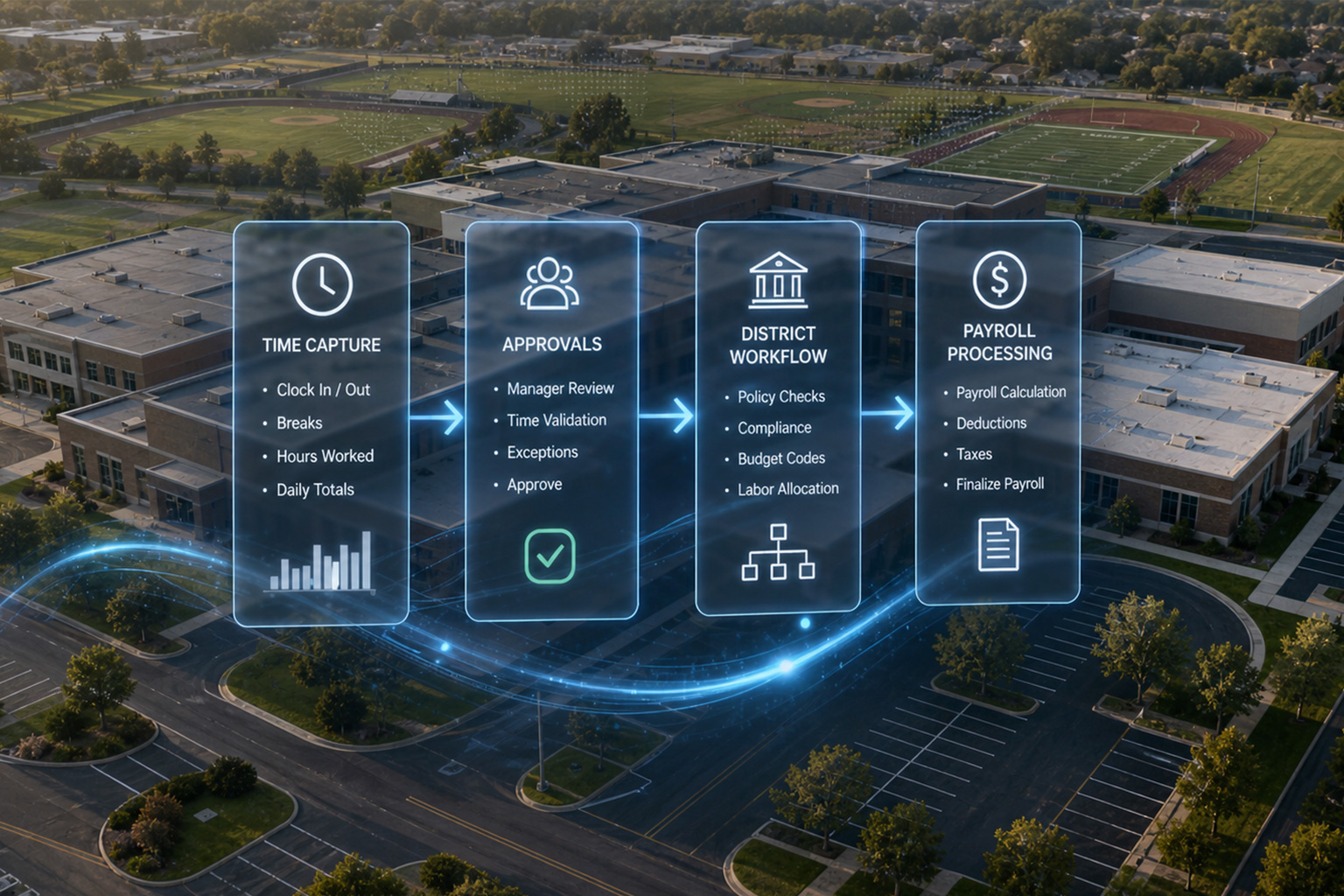
This is why replacing time tracking technology should never be treated as a device-only or software-only decision. Districts need to examine the entire clock-to-payroll workflow:
- how time is captured
- how exceptions are flagged
- how approvals happen
- how corrections are handled
- how payroll receives and validates final records
- where delays and rework typically enter the process
If that workflow is messy today, replacing one component will not create a clean outcome on its own.
A better question is not just, “What technology should we buy?”
It is, “What workflow should the technology support?”
Fix #5: Weak Visibility Into District-Wide Problems
One of the most expensive patterns in district timekeeping is late discovery.
Problems often surface only after they have already moved downstream. A missed punch becomes a correction. A pattern of inconsistent approvals becomes payroll rework. A campus with chronic issues continues operating the same way because no one has clear enough visibility to spot the pattern early.
That is costly for two reasons.
First, late problems are more disruptive than early ones. They are harder to fix, more visible to employees, and more likely to damage trust.
Second, weak visibility makes it hard to lead system-wide improvement. If district leaders cannot clearly see where friction is concentrated, they cannot prioritize the right fixes, support the right campuses, or hold the right people accountable.
Before replacing technology, large districts should identify whether they can answer questions like:
- which campuses generate the most exceptions
- which employee groups experience the most timekeeping friction
- where approvals slow down
- where payroll corrections are most common
- whether problems are isolated or systemic
If the district cannot see those patterns today, it should not assume a new system alone will create clarity without a broader effort to define standards, ownership, and workflows.
Fix #6: Outdated District Standards
Some districts try to solve timekeeping pain by asking, “What should we replace?”
A better starting point is, “What standard are we trying to create?”
Large districts need a district-wide vision for how workforce time should be captured, reviewed, escalated, corrected, and moved into payroll. Without that standard, every technology evaluation risks turning into a feature comparison instead of an operational strategy.
That leads to bad outcomes:
- buying based on isolated pain instead of district-wide need
- solving one department’s problem while preserving another’s
- overvaluing features and undervaluing consistency
- choosing tools without a clear rollout model
- creating uneven adoption across campuses
District standards do not need to be bloated or bureaucratic. They need to be clear enough that the district knows what “good” looks like before new technology enters the picture.
What Districts Lose When They Skip These Fixes
The status quo is not free.
When large districts delay fixing the root causes of timekeeping friction, they keep paying for them in other ways.
- They lose consistency as schools and departments continue relying on local workarounds.
- They lose time as payroll, HR, and site leaders spend hours on corrections, follow-up, and manual cleanup.
- They lose confidence as recurring exceptions make payroll feel more reactive and less reliable.
- They lose visibility as problems stay hidden until they become disruptive.
- They lose central-office capacity as skilled staff stay stuck in administrative drag instead of process improvement.
- And they lose employee trust when the same payroll and timekeeping frustrations keep resurfacing.
That is the trap districts should avoid. Replacing technology without fixing the underlying operating issues can create the appearance of progress while preserving the real costs of fragmentation.
What Better Looks Like
The goal is not simply newer technology.
For large districts, the goal is a stronger workforce time infrastructure.
That means:
- more consistent time capture across campuses
- fewer exceptions and manual interventions
- clearer accountability
- cleaner workflows into payroll
- earlier visibility into recurring issues
- more confidence that district policy is being followed consistently
- a scalable foundation for connected workforce operations
When those pieces are in place, technology replacement becomes more effective because it is supporting a better model, not compensating for a broken one.
Where Touchpoint Fits
This is where Touchpoint can help.
Large districts do not just need devices or software. They need a district-wide workforce time infrastructure partner that understands how timekeeping problems spread across campuses, employee groups, and central-office workflows.
With more than a decade of experience solving K-12 timekeeping problems for school districts, Touchpoint helps large districts standardize time capture, reduce payroll friction, and create a more scalable foundation for connected workforce operations. That means helping districts look beyond the surface-level symptoms and address the deeper issues that make timekeeping feel harder, slower, and less reliable than it should.
In other words, the right move is not just replacing old technology. It is building a stronger district-wide approach so new technology can actually deliver what district leaders expect.
Before You Replace, Fix the Foundation
If your district is feeling pressure to replace time tracking technology, that may be the right conversation to have.
But it should not be the first one.
First, fix the issues that create friction regardless of platform:
- inconsistent campus practices
- unclear ownership
- exception-heavy workflows
- disconnected clock-to-payroll processes
- weak visibility
- outdated district standards
Because for large districts, the biggest risk is not waiting too long to buy new technology.
It is buying new technology too soon, and bringing the same old chaos with it.
Want to evaluate whether your district is ready for a better timekeeping foundation? Touchpoint can help you assess where inconsistency, workflow friction, and payroll drag are creating avoidable problems across your campuses. Request a summer payroll friction review.

Rand Habegger
Rand Habegger is a seasoned veteran of EdTech, with nearly two decades' experience helping unsung underdogs in school district offices identify solutions to unique K-12 problems. When he's not helping educators discover breakthroughs, you might find him snowboarding with his kids, performing in a local music theater production (also with his kids), or thoughtfully sipping a vanilla cream soda he hasn't ranked yet.